Types of Trout Fish You May Catch
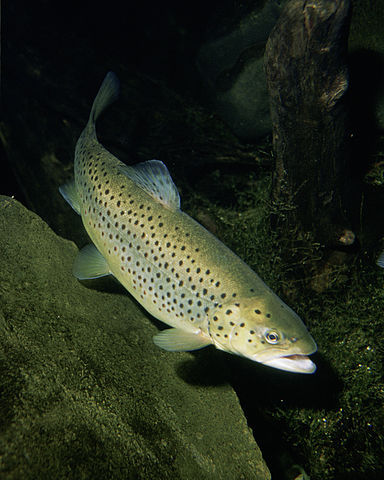
When you start fishing as a beginner a trout is a
trout and that’s that. It is only when you ‘gear up’ in the sport that you learn
of the different kinds of trout there are in rivers and lakes. All trout are
members of the Salmonidae family (which includes the fish from which their name
is derived –the salmon). These are:
- Brown trout Salmo trutta
- Seatrout Salmo trutta
- Rainbow Salmo gairdneri
- Cutthroat trout Salmo clarki
- Brook trout Salvelinus fontinalis
- Dolly Varden Salvelinus malma
- Grayling Thymallus thymallus
In Britain the trout you will catch will be the brown
trout, the rainbow trout and occasionally the brook trout.
If you like fishing in winter you may go after the grayling on rivers where this
fish breeds at the opposite season to the trout.
The Rainbow Trout
Since rainbow trout have an irrepressible urge to go
downriver to reach the sea – much to the annoyance of fish farmers who have to
‘lock them up. In lakes pools –
fish for trout in
stillwaters, mostly reservoirs which are regularly stocked with their brown
trout cousins. Some lakes also have brook trout stocked with their brown trout
cousins. Some lakes also have brook trout stocked in them, as these fish are
excellent fighters. Of course, among the brown trout there are various strains
with slightly different characteristics. Loch Leven trout from Scotland, for
example, are famed all over the world for fighting qualities. And the
yellowbellies from the River Don in Aberdeen shire are also famous among
anglers. Some lakes, especially in Ireland, have Gillaroo trout.
The SeaTrout
Although the seatrout is basically a brown trout which learned to migrate to the
sea to get good feeding, for the angler it is something much more than that. In
the first place, it is a comparatively rare fish in Britain, being found in
rivers – and in a few Scottish lochs – around Ireland, Wales and Scotland.
England has very few rivers supporting seatrout. Another feature exemplifying
its scarcity for the angler is the fact that the seatrout migration into rivers
usually only lasts a few weeks – from May till the end of July in most cases.
There is one other aspect of angling for seatrout
which prohibits it being widely practiced – they are best fished for at night.
Indeed on some rivers this is the only feasible time to be angling for the. In
Scotland. However, daytime fishing for the young, virgin seatrout is
particularly popular. These are called by various names in different parts of
the country –Finnock, Herling, Whitefish etc. So far as the Cutthroat and
Dolly Varden trout
are concerned, you have to go to America and Canada to catch these.
In the moorland streams and hill burns which emanate
from peaty soil, the usual size of trout caught is in half-pound or more. In the
chalk streams in the south of England three and four pounds are not unusual.
Then in the stillwaters with brown and rainbow trout, the sky is almost the
limit these days. Rainbow of ten to fifteen pounds have been caught. In
Scotland, seatrout caught –mainly at night—can really be any size from one to
ten pounds. Indeed the record so far is over twenty pounds !